
Division of Autism Services
Overview
The Mississippi Department of Mental Health is proud to introduce the Division of Autism Services, established under House Bill 807 during the 2025 Regular Legislative Session. Housed within DMH’s Bureau of Intellectual and Developmental Disabilities, the division was created in response to the need for a statewide, coordinated system of care for individuals with Autism Spectrum Disorder and their families.
Our division is committed to connecting Mississippians with the services, tools and guidance they need to live full, self-directed lives in their communities. Whether you are newly navigating an autism diagnosis, seeking additional support, or looking for resources to better serve the individuals in your care, the Division of Autism Services is here to help every step of the way.
Autism Resource Guide
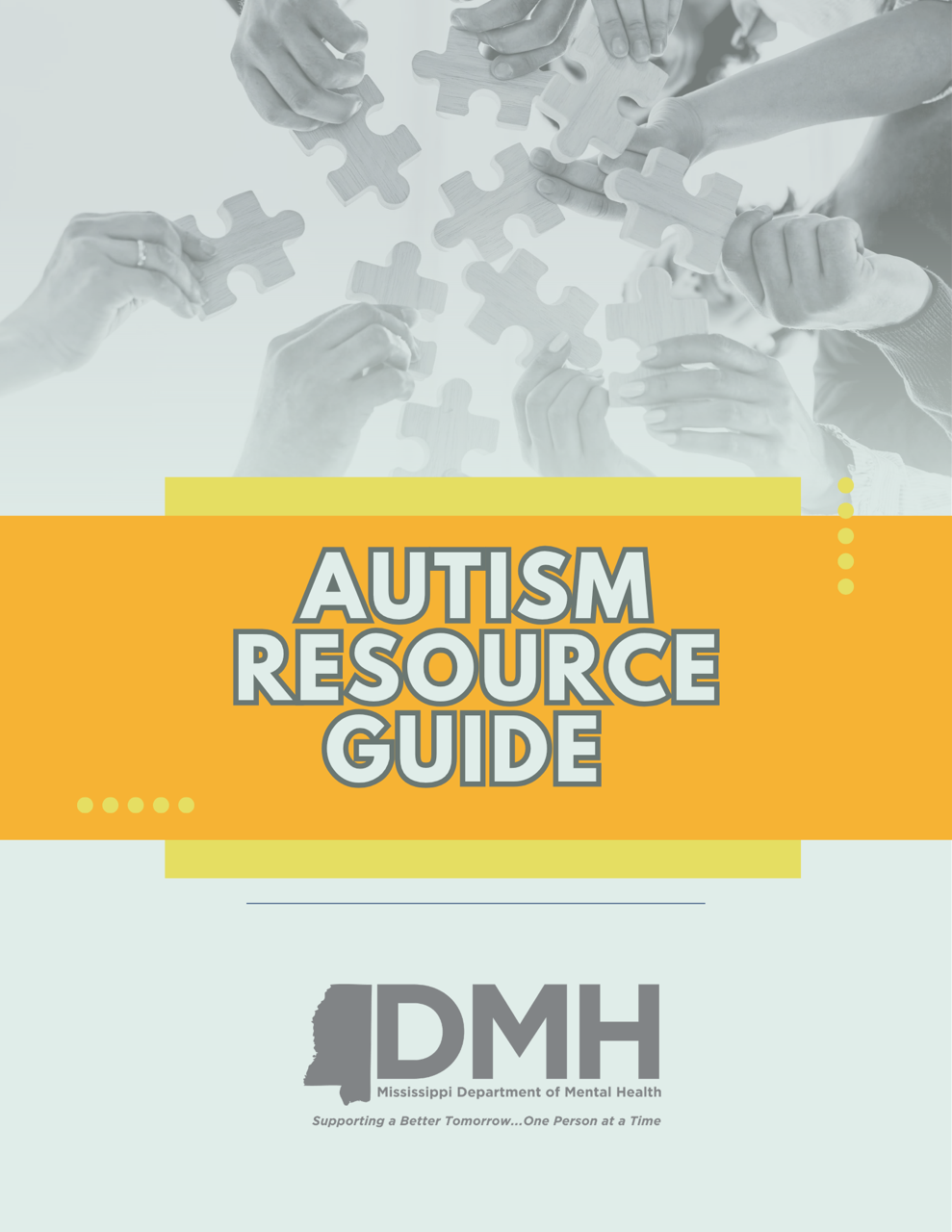
Through a joint effort with the Mississippi Department of Rehabilitation Services and the Arc of Mississippi, DMH has compiled this Autism Resource Guide to provide information for families seeking services.
The organizations on this list are not necessarily affiliated with DMH or DMH Certified Certified Providers. DMH is providing this document for informational purposes only. This is not a comprehensive list of autism-related services and other resources may be available near you. Click the image to view or download the guide.
For more information about services, please contact division director Shavvone Williams at shavvone.williams@dmh.ms.gov.
We Want to Hear From You!
The Division of Autism Services is committed to continuously improving support for individuals and families across Mississippi. Share your feedback and help shape the services that matter most to your community.
About Autism Spectrum Disorder
Autism Spectrum Disorder (ASD) is a neurodevelopmental condition that affects how a person communicates, learns and experiences the world around them. Because autism is a spectrum, no two individuals experience it the same way — strengths, challenges and support needs vary widely from person to person.
Autism is one of the most common developmental conditions in the United States. According to the Centers for Disease Control and Prevention (CDC), approximately 1 in 31 children in the U.S. has been identified with ASD. In Mississippi, thousands of individuals across all ages and backgrounds are living with autism.

ASD is typically identified in early childhood, though many individuals receive a diagnosis later in life. Common characteristics may include:
- Differences in social communication and interaction
- Repetitive behaviors or routines
- Heightened or reduced sensitivity to sensory experiences
- Highly focused interests or areas of expertise
- Differences in learning style or information processing
It is important to recognize that autism is not a barrier to a meaningful and fulfilling life. With the right supports and opportunities, individuals with autism can and do thrive in their homes, schools, workplaces and communities.
Mississippi Insurance Department Resources
 The Mississippi Insurance Department is charged with enforcing all laws that apply to the business of insurance in the state of Mississippi, including those related to insurance coverage for various treatments for autism and autism spectrum disorders. It also has established a licensure process for certain providers of autism services.
Autism Hotline – 1-833-488-6472
This hotline helps consumers with issues regarding health insurance benefits for screening, diagnosis, and treatment. If you have questions about your coverage or if you feel your rights are being violated, please contact this MID hotline. Consumer representatives are available between the hours of 8:00 am and 5:00 pm central time at 1-833-488-6472 or via email at: consumer@mid.ms.gov.
- Miss. Code Ann. §83-9-26 – Read the law
- Autism Parent Resource Center
- Autism Provider Resource Center
- Insurance Complaints Guide – For both Consumers and Providers
- Board of Autism list of certified Mississippi Licensed Behavior Analysts
- What does Medicaid cover? – Follow this link to contact the Mississippi Division of Medicaid, Division of Mental Health
- 2019 ABA CPT Code Update Overview
- Adaptive Behavior Assessment and Treatment Code Conversion Table
- New CPT Codes for Adaptive Behavior Services- What ABA Providers Need to Know- Webinar
- BACB: Applied Behavior Analysis Treatment of Autism Spectrum Disorder: Practice Guidelines for Healthcare Funders and Managers
- Association of Professional Behavior Analysts: Identifying Applied Behavior Analysis Interventions
- Association of Professional Behavior Analysts Healthcare Provider Taxonomy Codes
This information has been provided from the Mississippi Insurance Department. Please visit their site for more information, including many more questions asked and answered: Autism – Official Website of the Mississippi Insurance Department
The law states that a health insurance policy shall provide coverage for the screening, diagnosis, and treatment of autism spectrum disorder. To the extent that the screening, diagnosis, and treatment of autism spectrum disorder are not already covered by a health insurance policy, coverage under this section will be included in health insurance policies that are delivered, executed, issued, amended, adjusted, or renewed in this state, or outside this state if insuring residents of this state, on or after January 1, 2016. No insurer can terminate coverage, or refuse to deliver, execute, issue, amend, adjust, or renew coverage to an individual solely because the individual is diagnosed with or has received treatment for an autism spectrum disorder.
No. The new law requires coverage for any of the pervasive developmental disorders or autism spectrum disorders as defined by the most recent edition of the Diagnostic and Statistical Manual of Mental Disorders (“DSM”).
The autism coverage mandate applies to:
- All large group health insurance plans.
- All “grandfathered” health plans sold in the individual, and small group markets.
- A “grandfathered” health plan is a health plan that was in place before March 23, 2010, when the Affordable Care Act was signed into law.
- Non-grandfathered plans in the individual and small group market are specifically excluded from the requirements of the ASD statute.
- All small employers are required to offer coverage required by the ASD statute but may charge the plan participant with the cost of obtaining the additional coverage.
- The following types of plans are not required to comply with Miss. Code Ann. §83-9-26 et Seq.:
- Non-grandfathered plans in the individual and small group markets that are required to include essential health benefits under the Patient Protection and Affordable Care Act (“ACA”)
- Self-funded health benefit plans that, under ERISA, do not have to comply with state insurance laws
- Medicare supplement,
- Accident-only,
- Specified disease,
- Hospital indemnity,
- Disability income,
- Long-term care, or
- Other limited benefit hospital insurance policies.
- In “self-insured” or “self-funded” plans, the employer pays medical claims directly, rather than purchasing a group insurance policy. In many cases, these employers will hire an insurance company to administer the plan and pay claims for them. However, ultimately, the employer decides on the coverage and pays the claims. Many of these self-insured plans are exempt from state insurance laws, including the new autism law.
The new law requires carriers to provide coverage for the screening, diagnosis, and treatment of autism spectrum disorder. Treatment of ASD is defined broadly and includes all of the following:
1. Behavioral health treatment – includes applied behavior analysis (“ABA”) therapy.
2. Pharmacy care
3. Psychiatric care
4. Psychological care
5. Therapeutic care – includes services provided by licensed speech-language pathologists, occupational therapists, or physical therapists as covered by the health insurance policy.
The law does not create a new mandate for plans to begin covering these services, but if a plan does cover these services then there cannot be an exclusion for these services that only applies to individuals diagnosed with ASD.
Psychiatric and Psychological care is defined as direct or consultative services provided by a Mississippi-licensed psychiatrist or psychologist respectively.
Behavioral health treatment is defined as any behavior modification and mental health counseling and treatment programs, including applied behavior analysis (ABA) therapy, that are necessary to develop or restore, to the maximum extent practicable, the functioning of an individual. These services must be provided or supervised by a licensed behavior mental health professional, so long as the services performed are commensurate with the licensed mental health professional’s competency area, training and supervised experience.
Therapeutic care includes services provided by licensed speech-language pathologists, occupational therapists, or physical therapists as covered by the health insurance policy.
Note – The law does not create a new mandate for plans to begin covering these services, but if a plan does cover these services then there cannot be an exclusion for these services that only applies to individuals diagnosed with ASD.
Under the new law, ABA is defined as, “the individualized design, implementation, and evaluation of instructional and environmental modifications to produce socially significant improvement in human behavior, including the use of direct observation, measurement, and functional analysis of the relationship between environment and behavior.”
Yes. The benefit for ABA therapy shall be limited to twenty-five (25) hours per week, and shall not be required beyond the age of eight (8) years.
No more than ten (10) hours per week shall be for the services of a licensed behavior analyst; however, all services must be provided under the supervision or direction of a licensed behavior analyst or licensed psychologist.
However, coverage for applied behavior analysis pursuant to an ongoing treatment plan may be extended beyond the limits provided in this subsection if medical necessity for the extension is determined to exist, or in the event of disagreement, the appeal rights under the applicable health insurance policy shall govern.
The Mississippi Secretary of State’s Office oversees licensing of autism service providers through the Mississippi Autism Board. To see if your provider is licensed in Mississippi you can contact the board by phone at 601-359-6792 or online at http://sos.ms.gov/autismboard/.
Frequently Asked Questions
Mississippi Autism Advisory Committee Reports
2025 Mississippi Autism Advisory Committee Report
2024 Mississippi Autism Advisory Committee Report
2024 Mississippi Autism Advisory Committee Summary
2023 Mississippi Autism Advisory Committee Report Summary
2023 Mississippi Autism Advisory Committee Annual Report
2022 Mississippi Autism Advisory Committee Report
2021 Mississippi Autism Advisory Committee Summary
2020 Mississippi Autism Advisory Committee Report
2019 Mississippi Autism Advisory Committee Summary
2019 Mississippi Autism Advisory Committee Report
2018 Autism Spectrum Disorder Strategic Plan for Mississippi
2018 Mississippi Autism Advisory Committee Summary
2018 Mississippi Autism Advisory Committee Report
2017 Autism Spectrum Disorder Strategic Plan for Mississippi
2017 Mississippi Autism Advisory Committee Report
2016 Mississippi Autism Advisory Committee Report
2015 Mississippi Autism Advisory Committee Report
2014 Mississippi Autism Advisory Committee Report
2013 Mississippi Autism Advisory Committee Report
2012 Mississippi Autism Advisory Committee Report